Treatment decisions: breakage or thinning
Hair breaking, not growing? Breakage vs thinning, and what strand serums can do
Breakage is a problem with the hair fibre. Shedding and thinning start at the follicle. They need different fixes, so it pays to know which one you have.
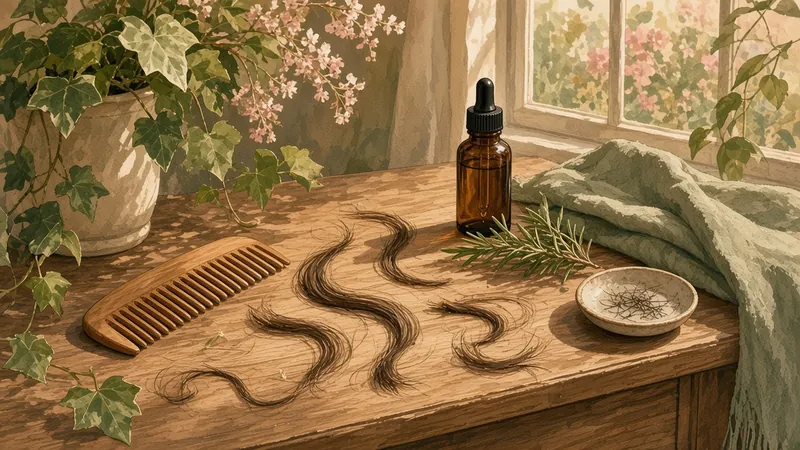
The short answer
Breakage happens along the hair shaft, so the follicle keeps growing and the fix is gentler care for the fibre12. Shedding and thinning start at the follicle, usually from a trigger, low iron, thyroid changes or pattern hair loss, and no product applied to the lengths can reach that34. If your pieces are short with no bulb, start with the strand. If whole hairs with a white bulb are falling, or your part is widening, test first.
Three problems that look alike in the mirror
Many women describe all three as "my hair is thinning", but they have different causes and different fixes. Shedding means whole hairs are leaving the follicle, often months after a trigger such as illness, surgery, a crash diet or childbirth35. Pattern thinning means the follicles themselves are slowly producing finer, shorter hairs, most often on the top of the head and along the part6. Breakage means a hair snaps somewhere along its length while the follicle carries on growing1.
| Breakage | Shedding | Pattern thinning | |
|---|---|---|---|
| What the fallen hair looks like | Short or uneven pieces, blunt or frayed ends, no bulb | Full-length hairs with a small white bulb at the root | Often no dramatic fall; hairs get finer and shorter over time |
| Where you notice it | Ends, the crown where hair rubs, the hairline under tight styles | All over the scalp, in the shower drain and on the brush | Widening centre part, more scalp showing on top |
| Usual drivers | Heat, bleach, relaxers, rough towel drying, tight styles, brushing wet hair1 | A trigger two to four months earlier, low iron, thyroid changes57 | Genetics and androgen sensitivity, more common after menopause68 |
| Where the fix happens | The hair fibre | Finding and removing the cause | The follicle, with treatment for months |
The 60-second strand check
Collect the hairs from one wash or one brushing session on a sheet of white paper and look closely, in daylight if you can.
- Look at one end of each hair. A tiny white or translucent bulb means the hair came out from the root. That is shed hair, and up to about 100 a day is normal3.
- Compare lengths. Lots of short pieces of different lengths, with no bulb, point to breakage.
- Check the ends on your head. Split, white-dotted or frayed ends, and hair that will not grow past a certain length, also point to breakage.
- Look at your part in the mirror. A part that looks wider than it did a year ago suggests pattern thinning, whatever else is going on. Monthly photos in the same light make this easier to judge.
- Think back three months. A fever, an operation, a new medicine, a big change in eating or a birth in that window makes shedding more likely5.
Plenty of women have more than one at once. Fragile, overprocessed hair can break while a shed is running, and breakage makes existing thinning look worse. If you are unsure, treat the strand gently and test anyway.
Why strand serums are suddenly a hair-growth topic
In October 2026 one of the best-known hair supplement brands launched its first strand serum, marketed for breakage, split ends and heat protection, with laboratory percentages for stronger hair and less breakage. That is a fair and useful category: plenty of women who think they are losing hair are actually losing length to breakage. The brand presents these as results of its own testing, and we report them as the brand's claims rather than independent findings.
It helps to know what this kind of product works on. Conditioning and bond-care ingredients act on the cuticle and cortex of the hair shaft: they smooth the surface, reduce friction and static, and make the fibre less likely to snap when combed or heated2. Strength and breakage figures for hair products usually come from measurements on hair fibres, such as how much force a strand takes before it breaks or how many pieces break off during combing. These tell you about the fibre you already have. They do not tell you anything about how many follicles are growing hair.
What a strand product can and cannot do
| Can help with | Cannot fix |
|---|---|
| Snapping, split ends and frizz from heat, colour or chemical services2 | Shedding from a trigger, which comes from the follicle resting phase5 |
| Keeping length you have grown, so hair looks fuller at the ends | A widening part from pattern hair loss6 |
| Smoother combing, which reduces mechanical damage1 | Shedding linked to low iron or thyroid disease, which needs testing and medical care79 |
| Hair that feels softer and less brittle | Patches, pain, burning or a shiny scalp, which need a dermatologist10 |
So a strand product is the right tool when the problem is the strand. When the problem is the follicle, a stronger fibre just means the hairs you are losing are in better condition when they fall.
If it is breakage: a routine that protects length
The American Academy of Dermatology lists ten everyday habits that damage hair, and most of them are easy to change1:
- Massage shampoo into the scalp only, and let the rinse run through the lengths.
- Use conditioner after every wash.
- Wrap hair in a towel instead of rubbing it, and air dry when you can.
- Comb with a wide-tooth comb: when partly dry if your hair is straight, and while damp if it is textured or tightly curled.
- Use the lowest heat setting and limit hot tools, ideally to once a week or less.
- Space out colour, relaxers and perms, and have only one chemical service at a time.
- Choose looser styles and covered bands; tight ponytails, buns and heavy extensions add tension at the hairline111.
Give a gentler routine about three months before judging it, because the broken ends you see now were damaged in the past. If breakage clusters at the edges or under braids, read our textured hair and traction guide, because tension can damage follicles as well as fibres.
If it is shedding or a widening part: test first
Whole hairs with bulbs, more scalp on top, or shedding that has gone on for more than six months are follicle problems, and the usual next step is blood work. Guidelines for women with thinning suggest checking iron stores, thyroid function and, depending on symptoms, androgens4. Low ferritin is common in women with shedding and is easy to miss without a test7. Our labs guide explains each marker and what a result changes.
Once you know the cause, the plan follows from it: correcting a confirmed deficiency with your clinician, letting a trigger-related shed run its course, or starting a treatment for pattern thinning such as minoxidil or a laser cap. Our treatment decision guide compares the options, and the Hair Experts guide to regrowth versus breakage shows how to tell short new hairs from broken ones.
When to see a professional
See a dermatologist promptly for patches, a smooth or shiny area, scalp pain, burning or crusting, because some scarring conditions need early treatment10. For a full hair and scalp assessment, including help reading your results, you can find a trichologist.
Questions women ask
Can a strand serum make my hair grow back?
How can I tell a broken hair from a shed hair?
Look at the end. A shed hair has a small white bulb where it left the root and is usually full length. A broken hair has no bulb and is often shorter, with a blunt or frayed end3.
Can I have breakage and thinning at the same time?
How long until breakage improves?
Scalp hair grows roughly a centimetre a month, so damaged lengths take months to grow out. Expect the first clear difference after about three months of gentler care, and trim split ends rather than waiting for them to heal2.
Sources
- American Academy of Dermatology. How to stop damaging your hair: 10 hair-care habits that can damage your hair. Open source
- Gavazzoni Dias MF. Hair cosmetics: an overview. Int J Trichology. 2015;7(1):2-15. Open source
- American Academy of Dermatology. Do you have hair loss or hair shedding? Open source
- Carmina E, Azziz R, Bergfeld W, et al. Female pattern hair loss and androgen excess: a report from the Multidisciplinary Androgen Excess and PCOS Committee. J Clin Endocrinol Metab. 2019;104(7):2875-2891. Open source
- DermNet. Telogen effluvium. Open source
- American Academy of Dermatology. Thinning hair and hair loss: could it be female pattern hair loss? Open source
- Trost LB, Bergfeld WF, Calogeras E. The diagnosis and treatment of iron deficiency and its potential relationship to hair loss. J Am Acad Dermatol. 2006;54(5):824-844. Open source
- Anderson A, Konopelski P, Skorzewska K, et al. The role of hormones in female androgenetic alopecia: focus on menopause. Climacteric. 2026. Online ahead of print. Open source
- British Thyroid Foundation. Hair loss and thyroid disorders. Open source
- American Academy of Dermatology. Central centrifugal cicatricial alopecia: overview. Open source
- Billero V, Miteva M. Traction alopecia: the root of the problem. Clin Cosmet Investig Dermatol. 2018;11:149-159. Open source
Checked 17 November 2026. Read our editorial policy.